
);
Contattaci
LinkedIn Post 1
July 2025

Fertiga at the 41st ESHRE Annual Meeting in Paris, France

Fertiga, in collaboration with Brussels IVF and Merck KGaA, Darmstadt, Germany, has announced ground-breaking results from the AURORA-REC study on gene expression in ICSI patients treated with r-hFSH or r-hFSH & r-hLH. During AURORA-REC study we evaluated the differences in cumulus cell gene expression between two types of ovarian stimulation and proved that gene-based algorithms can predict live birth in these patient groups:

  • the accuracy achieved for women stimulated with r-hFSH was 69%
  • the accuracy achieved for women stimulated with r-hFSH & r-hLH was 88%

July 2025

Fertiga teams up with Fertilab Barcelona in AURORA-Donor study

Suppressing the pituitary gland is essential during ovarian stimulation. Traditionally done via daily GnRH-antagonist injections, this study compared that approach to an alternative: using oral progesterone (Medroxyprogesterone). The key takeaways from the AURORA-Donor study so far:

  1. Both protocols are equally effective in egg maturation, fertilization, blastocyst development, and genetic quality (euploidy).
  2. No significant difference in hormonal levels or stimulation duration, but the progesterone protocol is:
  • 💰 40x more cost-efficient
  • 💊 More patient-friendly (oral vs. daily injections)
  • 🧑‍⚕️ Easier for clinics to manage.

The next step? Exploring gene expression in cumulus cells to better predict outcomes like live birth – stay tuned for more from the AURORA-Donor study!

LinkedIn Post 1
November 2024

Fertiga presenting at ESHRE SIG Embryology Workshop!

Discover cutting-edge advancements in IVF technology, including non-invasive PGT-A, automatic vitrification, and AI-driven gamete and embryo selection at the ESHRE SIG Embryology Campus Event in Manchester, UK from 14-16 November 2024.

Don’t miss Tom Adriaenssens from Fertiga leading a hands-on session on ‘Non-invasive pregnancy prediction based on cumulus cells (AURORA-Test) in routine ART: The practical application, impact and challenges’.

LinkedIn Post 1
July 2022

Fertiga at the 38th annual ESHRE meeting in Milan

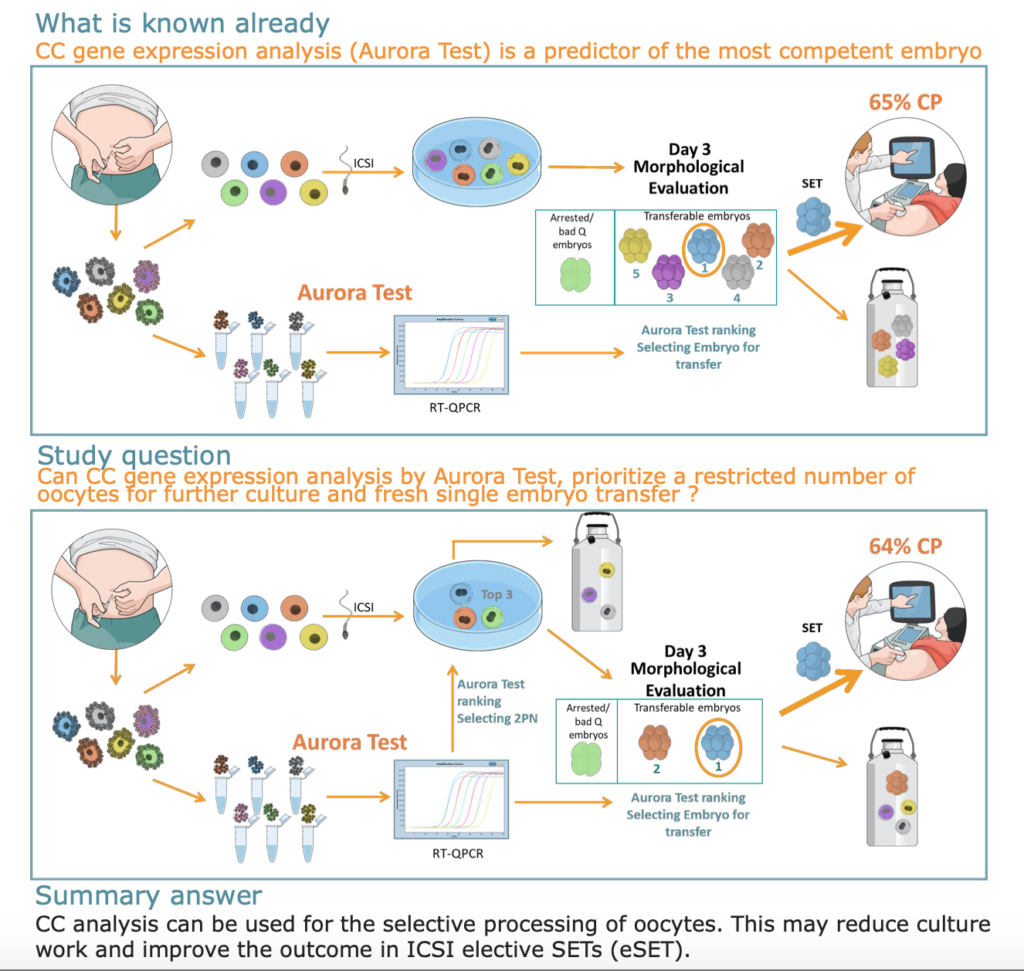
In July 2022, Fertiga attended the 38th annual ESHRE meeting (European Society of Human Reproduction and Embryology) in Milan to present its latest results. The poster was titled “Cumulus cell analysis as a non-invasive oocyte selection strategy to reduce the number of oocytes/embryos cultured and increase pregnancy rates”.

The Aurora Test is a predictor of the most competent embryo. Generally, the test has been used to select transferable Day-3 embryos. A retrospective analysis of Van Vaerenbergh et al. (2021) investigated whether the Aurora Test could also be applied to select oocytes on Day 1. Therefore, a subset of 80 patients was selected. On average, these patients had 8 large pre-ovulatory follicles on trigger day and at least 4 2PN oocytes. The team then studied the effect of processing only the three highest-ranking oocytes with the Aurora Test. These were then compared to the processing of all oocytes.

The study concludes that cumulus cell analysis may reduce culture work and improve the outcome in ICSI eSET. By performing the Aurora Test, patients benefit from a higher pregnancy rate in the fresh transfer cycle. The oocyte selection strategy results in a reduction of embryo culture and evaluation work.