


Not all oocytes are equal… but now you can tell which ones will thrive
The Aurora niPCT™ is the first clinically proven, non-invasive test that looks at what truly matters: the oocyte’s biological potential itself. By analysing the cumulus cells that naturally surround and support the egg, Aurora niPCT™ decodes the molecular signals of highest potential. Unlike imaging or culture-based assessments, it doesn’t guess — it measures. Unlike invasive genetic testing, it causes no harm. And unlike many emerging tools, it is already validated in clinical practice, where it has significantly increased pregnancy and live birth rates on the very first transfer.
The Aurora niPCT™ accuracy for a live birth for patients stimulated with
* after analysing cumulus cells of > 1000 oocytes (Van Vaerenbergh et al., 2021; Adriaenssens et al., 2019); ** after analysing cumulus cells of > 1000 oocytes (Adriaenssens et al., 2025).
Results of our studies
Increased live birth rate and clinical pregnancy rate for SET

Results of our latest prospective interventional study showed that in the Aurora niPCT™ test arm (also called Aurora Test) with single embryo transfer (SET) on day 3, the clinical pregnancy rate increased significantly from 27 % to 63 % in the first fresh transfer cycle. Compared to day 5 SET — from 43 % to 63 %. Moreover, significantly increased live birth rate was detected between day 3 transfers. These were ICSI patients stimulated with HP-hMG. In the control arms patients had morphological scoring only. Read more …
Increased cumulative pregnancy rate
In an earlier clinical study cumulative rates were followed up and the Aurora niPCT™ Test also significantly increased the cumulative pregnancy rate from 56% to 78% in comparison to the day 3 control group when the patient underwent consecutive cycles. Read more …
Increased pregnancy rate at a first try and shorter time-to-pregnancy rate

Results of our clinical study showed a significantly shorter time-to-pregnancy in the Aurora niPCT™ Test arm with fresh or frozen SET compared to control group. When considering all patients with at least two transferable embryos, three additional transfers were needed in the control arm to achieve the same clinical pregnancy. Read more …
Principle based on science
The Aurora niPCT™ is performed on cumulus cells surrounding the oocytes of a patient and it is based on the measurement of the expression of specific genes. Cumulus cells are individually removed from each oocyte and RNA is extracted from the cumulus cells. Real-time PCR is performed for predictive genes and two control genes that leads to a quantitative ranking for all oocytes. Find out more:
Aurora niPCT™ is applicable for
- fresh transfers
- frozen transfers
- donor cycles
- social oocyte freezing
The Aurora niPCT™ is performed on cumulus cells from all oocytes from a patient and follows the same molecular testing as for an ICSI patient. The oocytes are ranked, and then, in the future, the highest-ranked oocytes can be used first. The oocytes must be frozen individually. Read more….
Aurora niPCT™ service time line
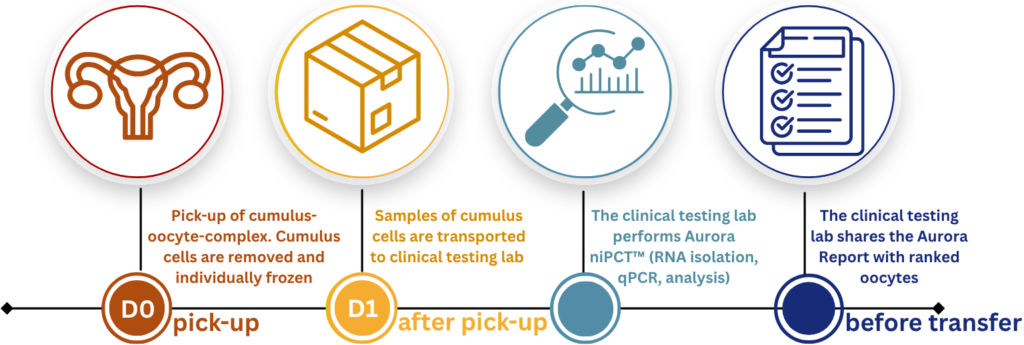
In case there is no pregnancy from the first transfer, the supernumerary embryos which were vitrified individually will also be transferred following the Aurora score.
If a frozen eSET is scheduled, the samples can be shipped later but must arrive at Fertiga’s clinical testing lab at least a week before the transfer.
If you want more information on Standardizing Pre-Analytical Conditions for Reliable Non-invasive Preimplantation Cumulus Cell Testing, contact us for a White paper.
Our research
- Adriaenssens T, Van Vaerenbergh I, Van Leuven W, Coucke W, Montenegro S, Zheng W, D’Hooghe T, Van Landuyt L, De Munck N, Van Hecke E, Smitz J, Rosenthal A, Blockeel C.Live birth in patients stimulated with r-hFSH or r-hFSH: r-hLH is strongly associated with cumulus cell derived gene expression models. Reprod Biol Endocrinol. 2025;23(163). doi:1186/s12958-025-01480-2
- Van Vaerenbergh I, Adriaenssens T, Coucke W, Van Landuyt L, Verheyen G, De Brucker M, Camus M, Platteau P, De Vos M, Van Hecke E, Rosenthal A, Smitz J. Improved clinical outcomes after non-invasive oocyte selection and Day 3 eSET in ICSI patients. Reprod Biol Endocrinol. 2021;19(1):26. doi: 1186/s12958-021-00704-5
- Adriaenssens T, Van Vaerenbergh I, Coucke W, Segers I, Verheyen G, Anckaert E, De Vos M, Smitz J. Cumulus-corona gene expression analysis combined with morphological embryo scoring in single embryo transfer cycles increases live birth after fresh transfer and decreases time to pregnancy. J Assist Reprod Genet. 2019;36(3):433-443. doi: 1007/s10815-018-01398-2
- Wathlet S, Adriaenssens T, Segers I, Verheyen G, Van Landuyt L, Coucke W, Devroey P, Smitz J. Pregnancy prediction in single embryo transfer cycles after ICSI using QPCR: validation in oocytes from the same cohort. PLoS One. 2013;8(4):e54226. doi: 1371/journal.pone.0054226
- Wathlet S, Adriaenssens T, Segers I, Verheyen G, Janssens R, Coucke W, Devroey P, Smitz J. New candidate genes to predict pregnancy outcome in single embryo transfer cycles when using cumulus cell gene expression. Fertil Steril. 2012;98(2):432-9.e1-4. doi: 1016/j.fertnstert.2012.05.007
- Wathlet S, Adriaenssens T, Segers I, Verheyen G, Van de Velde H, Coucke W, Ron El R, Devroey P, Smitz J. Cumulus cell gene expression predicts better cleavage-stage embryo or blastocyst development and pregnancy for ICSI patients. Hum Reprod. 2011;26(5):1035-51. doi: 1093/humrep/der036
- Adriaenssens T, Segers I, Wathlet S, Smitz J. The cumulus cell gene expression profile of oocytes with different nuclear maturity and potential for blastocyst formation. J Assist Reprod Genet. 2011;28(1):31-40. doi: 1007/s10815-010-9481-9
- Adriaenssens T, Wathlet S, Segers I, Verheyen G, De Vos A, Van der Elst J, Coucke W, Devroey P, Smitz J. Cumulus cell gene expression is associated with oocyte developmental quality and influenced by patient and treatment characteristics. Hum Reprod. 2010;25(5):1259-70. doi: 1093/humrep/deq049