
);
Contact
LinkedIn Post 1
July 2022

Fertiga at the 38th annual ESHRE meeting in Milan

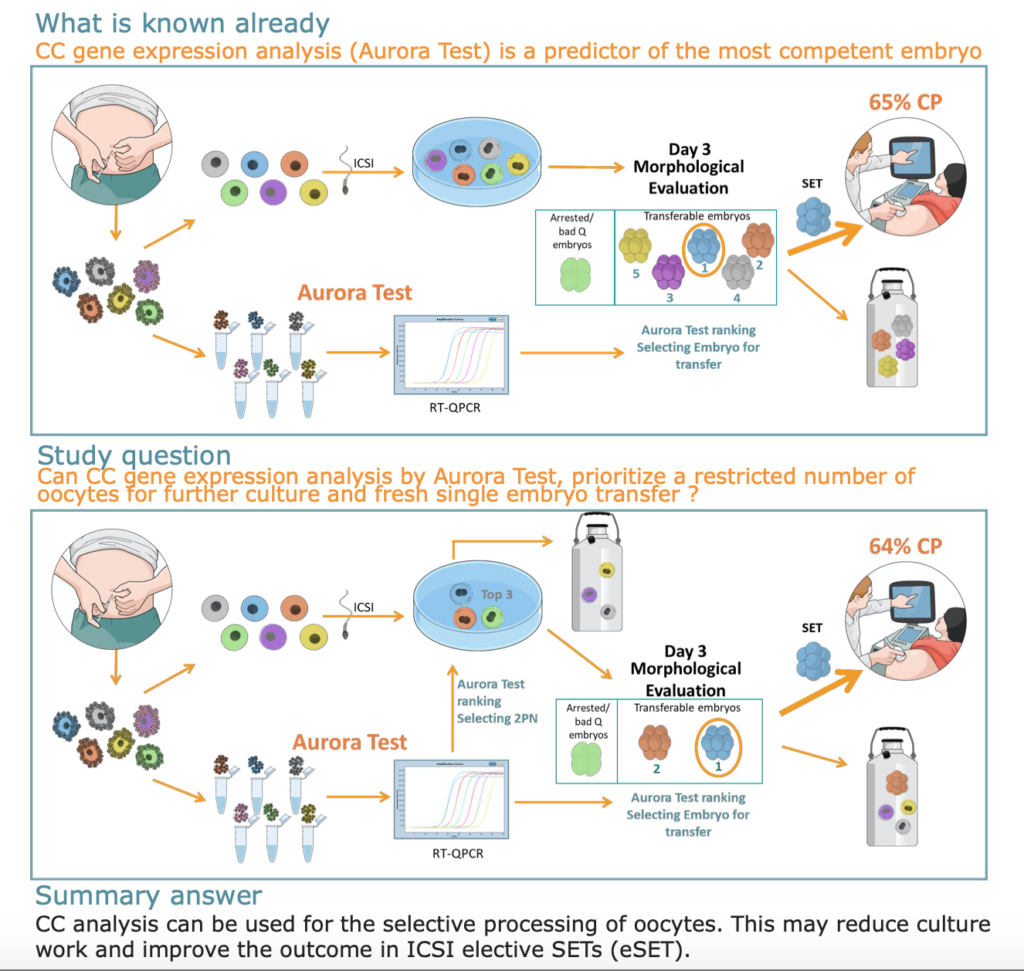
In July 2022, Fertiga attended the 38th annual ESHRE meeting (European Society of Human Reproduction and Embryology) in Milan to present its latest results. The poster was titled “Cumulus cell analysis as a non-invasive oocyte selection strategy to reduce the number of oocytes/embryos cultured and increase pregnancy rates”.

The Aurora Test is a predictor of the most competent embryo. Generally, the test has been used to select transferable Day-3 embryos. A retrospective analysis of Van Vaerenbergh et al. (2021) investigated whether the Aurora Test could also be applied to select oocytes on Day 1. Therefore, a subset of 80 patients was selected. On average, these patients had 8 large pre-ovulatory follicles on trigger day and at least 4 2PN oocytes. The team then studied the effect of processing only the three highest-ranking oocytes with the Aurora Test. These were then compared to the processing of all oocytes.

The study concludes that cumulus cell analysis may reduce culture work and improve the outcome in ICSI eSET. By performing the Aurora Test, patients benefit from a higher pregnancy rate in the fresh transfer cycle. The oocyte selection strategy results in a reduction of embryo culture and evaluation work.

LinkedIn Post 1
August 2021

In the spotlight in VUB News!

Fertiga is a spin-off company from one of the global IVF leading centers, UZ Brussel in Belgium. UZ Brussel has been pioneering IVF, with the first ICSI baby worldwide born in 1992 from the Center of Reproductive Medicine of UZ Brussels.

Fertiga is developing the Aurora test that doubles the chances of becoming pregnant after just one fertility treatment: it improves the prediction of which egg has the highest potential for pregnancy.

“One try, one child. That should always be the goal.” – Elien Van Hecke, co-founder..

LinkedIn Post 1
August 2021

In the spotlight in BioVox!

Fertiga, a spin-off company of the Vrije Universiteit Brussel (VUB), launched an innovation last year which considerably improve the efficiency of ICSI treatments: the Aurora test. A study with 633 patients showed that the test helped to double the pregnancy success rate of the first embryo transfer from 29 to 61 percent.

“This innovation saves people much time and emotional heartbreak,” says Elien Van Hecke, co-founder and Chief Commercial Officer (CCO) of Fertiga. “In Belgium, ICSI and IVF treatments are largely refunded by the social security system, but in countries where this is not the case the test can also save people a lot of money.”.

LinkedIn Post 1
May 2021

In the spotlight in De Tijd!

Belgium is the world leader in research into fertility problems in couples. The start-up Fertiga is the result of this. “Helping couples who want to have children, that’s what we do it for.”

💡The core message:

  • the Brussels start-up Fertiga has developed a test that doubles the chance of success from a first IVF attempt to more than 60 percent.
  • this test costs 1,000 to 1,500 euros and is already offered at UZ Brussel.
  • the roll-out in Belgium and in the rest of the world was delayed due to the pandemic.

LinkedIn Post 1
May 2021

We have been noticed by Foreign Affairs Belgium!

In vitro fertilization (IVF) can help women unable to naturally conceive to have a child. However, even if this expensive treatment is successful right away, it is still arduous for the couple. New technology developed by Fertiga ensures an enhanced success rate and increased comfort, while also highlighting Belgium’s position as a leader in the field of fertility research.

From a medical and health standpoint, the benefits are considerable, resulting in less physical and mental strain for the parents, saving them both time and money.

LinkedIn Post 1
February 2021

We have been published in Reproductive Biology and Endocrinology!

Non-invasive oocyte quality scoring, based on cumulus gene expression analysis, in combination with morphology scoring, can increase the clinical pregnancy (CPR) and live birth rates (LBR) in Day 3 eSET (elective single embryo transfer) ICSI patients. This was first investigated in a pilot study and is now confirmed in a large patient cohort of 633 patients. It was investigated whether CPR, LBR and time-to-pregnancy could be improved by analyzing the gene expression profile of three predictive genes in the cumulus cells, compared to patients with morphology-based embryo selection only.

💡The results of our study proved that:

  • the clinical pregnancy rate (CPR) was 61% in the Aurora test arm (n = 113) compared to 29% in the control arm (n = 520,  p < 0.0001).
  • the live birth rate (LBR) in the Aurora test arm (50%) was significantly higher than in the control arm (27%, p < 0.0001).
  • the time-to-pregnancy was significantly shortened by 3 transfer cycles independent of the number of embryos available on Day 3 (Kaplan-Meier, p < 0.0001).

EN